
Q&A with Rob Mottram, Head of Product & Compliance
As expectations around building performance continue to evolve, steel doorsets are required to deliver much more than security alone. Today’s specifiers need certified steel doorsets that combine security, fire performance, thermal efficiency, durability and compliance, all within a single tested system.
Rob Mottram, Head of Product & Compliance at Robust UK, discusses how changing market expectations are influencing steel doorset specification, the growing importance of third-party testing and certification, and why Secured by Design-approved doorsets are becoming increasingly important across residential, commercial and public sector projects.
Q: What do specifiers look for in doorsets?
A: Specifiers today are rarely looking for security in isolation. They want a steel doorset that delivers proven intrusion resistance, fire performance, durability, thermal efficiency, compliant escape hardware and a high-quality finish.
This is driving demand for third-party tested steel doorsets as customers increasingly look for verified performance rather than relying on manufacturer claims. There is also an expectation that doors arrive fully assembled with pre-fitted hardware, enabling quicker installation with less reliance on site interpretation.
We’ve seen growing interest in multi-performing doorsets such as GLAS-DOR, OUTA-DOR THERM and SECUR-DOR 2.1, reflecting a clear shift towards combining strong technical performance with visual quality.
The key is not compromise, but choosing the right certified steel doorset and tailoring it to the project so it delivers exactly the level of performance required without being over- or underspecified.
Q: How do you balance security, compliance and design requirements in a steel doorset?
A: The balance comes from designing the doorset as a complete system. Security starts with the fundamentals, including leaf construction, frame strength and hardware selection. Performance extends into fire resistance, acoustic control, thermal transmittance, corrosion resistance and operational durability.
Design quality comes when those requirements are integrated properly through flush detailing, glazing options and colour selection.
To achieve Secured by Design approval, a doorset must demonstrate enhanced security by meeting a certified standard such as PAS 24 (2022) or LPS 1175, both of which assess a doorset’s ability to resist forced entry and criminal attack.
Q: How does Robust UK stay ahead of changes in steel doorset standards and regulations?
A: From a product and compliance perspective, the key is to stay ahead of changes in standards, regulations and security threats, then translate those changes into practical design decisions.
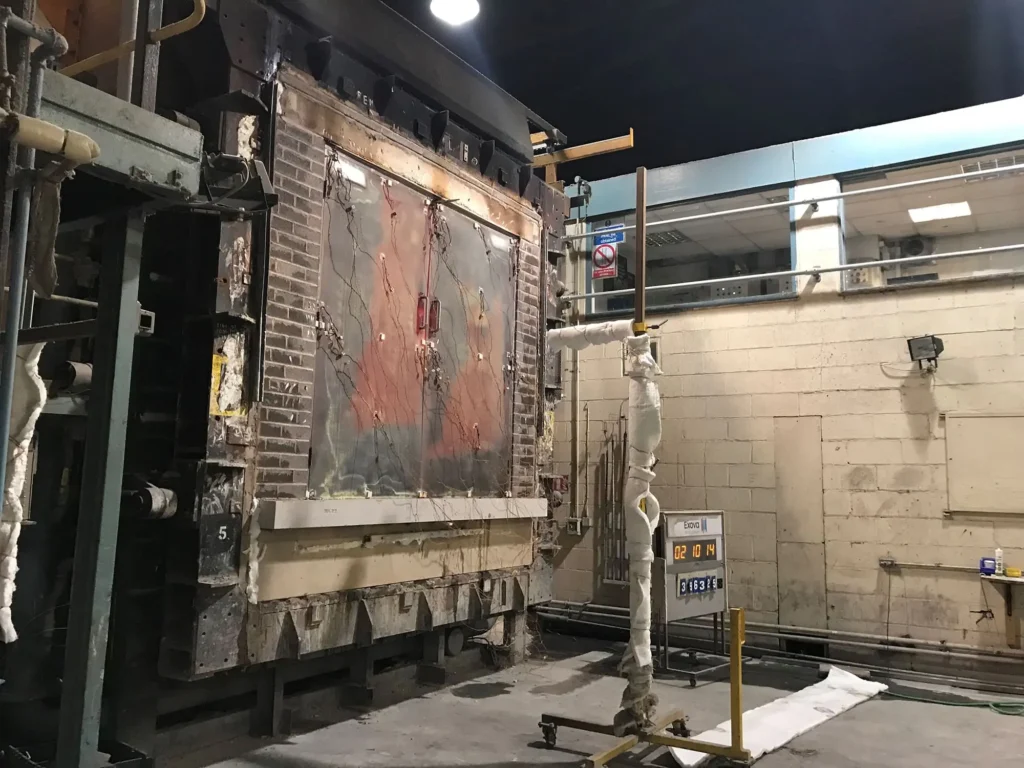
Our approach is built around continual investment in independent testing and certification with organisations including Secured by Design (SBD), the Loss Prevention Certification Board (LPCB) and United Kingdom Testing and Certification (UKTC).
By maintaining a strong focus on testing and compliance, we can continue to develop steel doorsets that meet changing industry requirements while delivering reliable performance in real-world applications.
Q: What is Secured by Design, and why does it matter?
A: Secured by Design (SBD) is a recognised police-backed accreditation scheme that identifies security products proven to meet defined performance standards.
For architects, contractors and end users, this provides additional assurance that a doorset has not only been tested but assessed against standards intended to reduce vulnerability to criminal attack.
Secured by Design-approved doorsets are supported by independently tested standards, helping support safer access strategies and satisfy planning, compliance and insurer expectations.
Q: At what stage does Secured by Design influence product development?
A: It influences product development from the very beginning.
If security compliance is treated as a late-stage addition, the product often becomes over-engineered, commercially inefficient or more difficult to certify. We begin by defining the risk level, application and certification route at the concept stage before developing the leaf, frame, reinforcement, hardware and ancillary details around the required performance level.
This approach is particularly important when a steel doorset must satisfy multiple requirements, including security, fire performance and operational durability.
In practice, Secured by Design and the standards that underpin it influence decisions ranging from hinge specification and vision panel design through to louvre selection and threshold arrangements.
Product development starts with the required certified performance and works backwards into the design rather than beginning with a generic doorset and attempting to achieve compliance afterwards.
Q: How can you recognise a Secured by Design-approved door?
A: The most reliable way to identify a Secured by Design-approved doorset is through certification and technical documentation rather than visual inspection.
Specifiers should look for evidence of Secured by Design approval alongside the relevant security standard, such as PAS 24 (2022), and ensure the supplied hardware and construction specification match the certified version.
Reputable steel doorset manufacturers will support this with technical data sheets, certification references and clear guidance on the scope of approval.
Q: Which Robust UK doorsets are Secured by Design approved?
A: Our Secured by Design-approved steel doorset range includes SECUR-DOR 2.1, TUFF-DOR 2.1, TUFF-DOR 3 and TUFF-VENT.
SECUR-DOR 2.1 is our versatile entry-level security doorset, certified to PAS 24:2022 and tested to the STS 201 security standard. It is designed to resist opportunist forced entry methods commonly associated with low- to medium-risk environments, including residential developments and social housing.
TUFF-DOR 2.1 offers enhanced protection with LPCB certification to LPS 1175 B3 (Issue 8), providing a higher level of security performance for more demanding applications.
TUFF-VENT addresses a specific market requirement for continuous airflow without compromising security. The fully louvred security doorset is ideal for plant rooms, service areas and ventilation-critical environments where tested security performance remains essential.
Across all three Secured by Design-approved doorsets, the principle remains the same: solving genuine application challenges through independently tested and certified solutions.
Q: What is it like being a Secured by Design member?
A: Being a Secured by Design member reflects our commitment to recognised security principles and independently tested standards.
It helps differentiate our products by demonstrating alignment with a respected police-backed benchmark while giving architects, contractors and end users confidence that our steel doorsets have verified security performance.
Ultimately, it helps reduce specification risk and supports safer, more secure building design.
Q: What developments in the steel doorset market are you most excited about?
A: The most exciting developments are those that directly address real-world specification challenges.
TUFF-VENT is a good example, resolving the long-standing conflict between ventilation and security by providing a fully louvred PAS 24-certified, Secured by Design-approved steel doorset.
More broadly, the market is moving towards application-specific solutions. Products such as RISER-DOR demonstrate how manufacturers are moving away from one-size-fits-all products and towards specialist doorsets designed to solve specific challenges, whether related to fire protection, thermal efficiency, security or installation practicality.
The most significant development, however, is the growing demand for integrated, certified and project-ready steel doorset systems that simplify specification while increasing confidence in compliance and performance.
Q: What’s next for Robust UK?
A: Our focus is on disciplined growth, expanding manufacturing capacity, increasing certification coverage and continuing to simplify specification and installation.
Following our move to a 7,900m² manufacturing facility in 2024, we have the capacity to continue developing technically robust, third-party certified steel doorsets that solve real project challenges.
At the same time, we remain committed to making those solutions easier to specify, easier to install and easier to deliver consistently because compliance only has real value when it can be achieved in practice.”
Expert Advice
For further guidance on specifying steel doorsets, contact us on 01782 592900 or email .